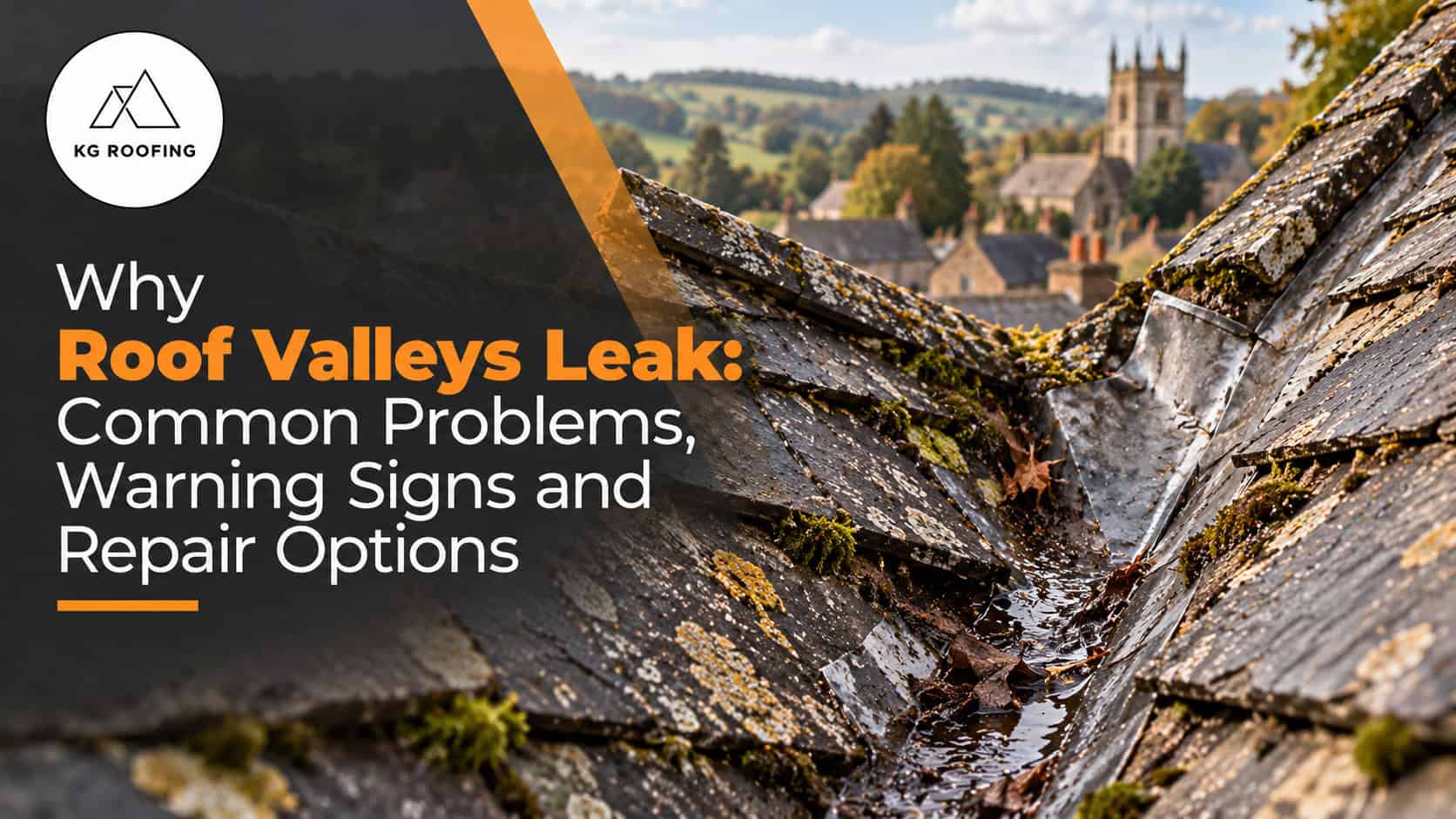
A leaking roof valley can cause a surprising amount of damage, particularly when the problem goes unnoticed during periods of heavy rain.
Roof valleys are the channels where two sloping sections of a roof meet. Their job is to collect rainwater and direct it towards the guttering. Because they carry more water than many other areas of a pitched roof, even a relatively small defect can cause problems.
For homeowners in Crediton, Exeter and the surrounding Devon area, understanding why roof valleys leak can help prevent damp, damaged ceilings and more expensive repairs.
At KG Roofing SW Ltd, we provide roof repairs and maintenance for pitched roofs, including problems involving valleys, leadwork and damaged roof coverings.
What Causes a Roof Valley to Leak?
There are several reasons why a roof valley might stop working properly. Some develop gradually as materials age, while others result from storm damage, poor installation or a build-up of debris.
1. Damaged or Deteriorating Valley Linings
Many roof valleys use lead or a purpose-made GRP valley trough to carry water safely down the roof.
Although these materials are designed to withstand exposure to the weather, they can eventually deteriorate. Lead can develop splits or fatigue damage, while other valley systems may become cracked, displaced or damaged.
Once the lining stops providing a continuous watertight channel, rainwater can reach the materials beneath the roof covering.
The correct repair depends on the condition of the valley. A small, isolated defect may be repairable, while more extensive deterioration could require the lining to be replaced.
2. Cracked Mortar Around Valley Edges
Some traditional tiled roof valleys have mortar along their edges.
As the roof ages, this mortar can crack, loosen or fall away. Deterioration may leave surrounding tiles less secure or expose weaknesses in the valley detail.
However, not every roof valley requires mortar. Modern dry-fix designs can provide effective alternatives depending on the roofing system.
The National Federation of Roofing Contractors provides further information about appropriate valley construction in its technical guidance on mortar in tiled valleys.
Simply adding more mortar over an existing problem is not always the right solution. The underlying condition of the valley needs to be assessed first.
3. Leaves, Moss and Debris
Blocked valleys are another common cause of roofing problems.
Leaves, moss and loose debris can collect where two roof slopes meet, particularly on properties surrounded by trees.
When enough material builds up, it can restrict water flow or cause rainwater to back up beneath nearby tiles.
This is worth watching for on homes around Crediton and the surrounding villages, including Sandford, Yeoford and Newton St Cyres, where established trees and exposed roof areas can make regular maintenance particularly useful.
A professional inspection and careful removal of debris may be enough if the valley lining and surrounding roof remain in good condition.
4. Broken or Poorly Positioned Roof Tiles
Sometimes the valley itself is not the main problem.
Cracked, slipped or incorrectly positioned tiles along the edge of the valley can allow water to enter beneath the roof covering.
This is particularly important where tiles have been cut to fit the angle of the valley. They need to be properly supported and secured so they remain in place during strong winds and heavy rain.
Replacing damaged tiles and correcting their position can often resolve a localised leak without requiring extensive roofing work.
5. Poor Installation or Incorrect Drainage
A roof valley must be correctly designed and installed to direct water away from the property.
Insufficient support, unsuitable overlaps, poor detailing or an incorrectly formed channel can contribute to recurring leaks.
These problems are not always visible from ground level and may only become apparent during heavy rainfall.
Where an installation defect is responsible, the affected section may need to be lifted and rebuilt rather than repeatedly patched.
Warning Signs of a Leaking Roof Valley
Roof valley leaks do not always cause water to drip directly into a room.
Rainwater can travel along underlay, roof timbers or other materials before eventually becoming visible inside the property.
Some warning signs include:
- Damp patches on ceilings or internal walls
- Water stains appearing after prolonged rainfall
- Wet insulation or roof timbers in the loft
- Visible cracks or deterioration along the valley
- Moss and debris building up in the drainage channel
- Slipped or broken tiles beside the valley
- Recurring leaks near the junction between two roof slopes
If you notice these problems, arranging a professional roof inspection and repair can help identify the cause before further damage develops.
How Are Leaking Roof Valleys Repaired?
The appropriate repair depends on why the valley is leaking and how much of the surrounding roof has been affected.
Clearing blocked valleys: If leaves, moss or debris are restricting drainage, the channel can be carefully cleared and inspected for damage.
Replacing damaged tiles: Broken or displaced tiles around the valley can often be replaced individually, provided the surrounding roof is still sound.
Repairing defective mortar: Loose or deteriorating mortar can be addressed where it forms part of the roof’s intended valley detail.
Replacing worn valley linings: Where the existing lead or GRP lining has deteriorated beyond an effective local repair, a replacement valley may be necessary.
Correcting installation problems: A poorly constructed valley may need more extensive work to restore suitable drainage and weather protection.
At KG Roofing SW Ltd, we carry out valley repairs alongside our wider roofing services. Where the problem is more extensive, our new roof and leadwork services include valley lining and roof junction work.
A complete roof replacement is not automatically necessary simply because a valley has started leaking.
Roof Valley Problems on Older Crediton Properties
Crediton has a mixture of traditional and modern properties, including older homes around the High Street and Church Street.
Some traditional roofs contain lead-lined valleys and slate coverings that have been in place for many years. These materials can remain serviceable for a long time, but existing valley details may eventually require attention.
When repairing an older roof, choosing materials and techniques that suit its construction is particularly important.
Properties within Crediton’s conservation area or those with listed status may also require additional consideration before significant roofing alterations take place.
Homeowners can find information through Mid Devon District Council’s conservation area guidance.
For most homeowners, the priority should be identifying the source of the leak and carrying out an appropriate repair while preserving the condition and appearance of the existing roof wherever practical.
Can You Prevent Roof Valley Leaks?
Not every leak can be prevented, but regular maintenance can reduce the likelihood of avoidable problems.
Keeping valleys clear, replacing damaged tiles promptly and checking for visible deterioration after severe weather are all sensible precautions.
Autumn is a particularly useful time to have valleys inspected, as fallen leaves and prolonged rainfall can expose drainage problems that were less noticeable during the summer.
Homeowners should avoid climbing onto roofs themselves. Roof valleys are often difficult to access safely, and walking on older tiles or slates can cause additional damage.
Professional Roof Valley Repairs in Crediton and Exeter
A leaking roof valley does not always mean major roofing work is required.
Sometimes the solution is as straightforward as replacing a damaged tile or clearing accumulated debris. In other cases, worn leadwork or an incorrectly installed valley may need more substantial attention.
The important thing is finding the actual cause rather than repeatedly treating the symptoms.
KG Roofing SW Ltd provides roof repairs, leadwork, roof maintenance and replacement roofing services throughout Crediton, Exeter and the surrounding Devon area.
Whether you have noticed damp inside your property, visible valley damage or a recurring roof leak, our team can assess the problem and recommend a practical solution.
Contact KG Roofing SW Ltd today for professional advice and a free, no-obligation quotation.
Want more info? Get in touch.
Give us a call today to get expert advice and support from our experienced team.